
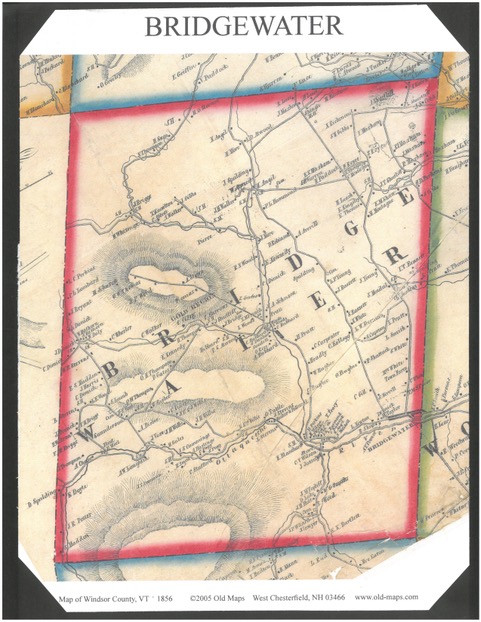
Bridgewater is a small village situated in Windsor County. Bridgewater Village, Bridgewater Corners, West Bridgewater, and Bridgewater Center (formerly called Briggs) are hamlets of Bridgewater. All of the hamlets and village, except the Center, are located along the Ottauquechee River, from which excellent water power was derived by diverting the waters of that river. The name, Bridgewater, stems from the many streams and the seventy bridges that crossed the waters in the 1800’s. Bridgewater boasted eight covered bridges in 1890!
Bridgewater was chartered July 10, 1761 under the reign of King George the Third on the advice of Benning Wentworth, Governor and Commander in Chief of the Province of New Hampshire. The charter defines the boundaries and divides the area into sixty-seven equal shares. Pioneer settlement of the town did not commence until some eight or nine years later during the time Vermont was an independent republic and while the thirteen colonies were fighting the war. First settler Asa Jones made his survey in the autumn of 1779 and in the spring of 1780 brought his family to live in Bridgewater. The second settler, Amos Mendell, came to Bridgewater in May 1780 and soon after married Deborah Jones and that was Bridgewater’s first wedding. Their daughter Lucy, born 1781, was Bridgewater’s first baby.
The early settlement of Bridgewater was exceedingly slow, and it was not until the year 1785 that the town had acquired a sufficient population to become organized. Prior to that time the proprietors held meetings and made such provision as was deemed necessary for the temporary government of the town, and such improvements as should tend to encourage settlement within its borders. The first meeting of the proprietors of the town was held in pursuance of an order issued by Justice Benjamin Emmons, of which the following is a copy: “State of Vermont, County of Windsor, whereas application hath been made to me, one of the justices of the peace of this State, by more than one-sixteenth part of the proprietors of the township of Bridgewater, to call a proprietors meeting for said township on Tuesday the l0th day of July next, to meet at the house of Captain John Strong, innholder in Woodstock, at nine o’clock in the forenoon, to act on the following articles, etc. “Benjamin Emmons, assistant. “Woodstock, May 18, 1781.”
In pursuance of this order the first proprietors’ meeting was held, as stated, on the l0th of July, at the public house then kept by Captain Strong. Asa Jones, the pioneer of Bridgewater, was chosen moderator; John Ransom, proprietors’ clerk; Asa Jones, proprietors’ treasurer; and James Cady, proprietors’ collector. The assembled proprietors then proceeded with the business of arranging for the regular survey of the town, and its division into hundred-acre lots. For this labor a committee was chosen, consisting of settlers Asa Jones, James Cady and Amos Mendall. The next meeting of the proprietors was held at Deacon Jones’s house in Bridgewater on the 24th of November, 1783. Among other things it was voted, at this time, to give Isaac and Richard Southgate two whole town rights (lots) in one body, provided they build two good mills, one a saw-mill and the other a grist-mill, within one year; but a subsequent meeting extended the time of building these mills to two years. The Southgates were further required to give the mills “good attendance” for a term of twenty years. Other hundred-acre lots were also granted to George Boyce and Captain John Hawkins, in consideration of their building saw-mills in the town.
At a meeting held at Woodstock in September, 1784, the proprietors appointed Captain Strong, Jesse Williams, Cephas Shedd, John Hawkins and Richard Southgate as a committee to lay out a road through the town. At this same meeting the proprietors granted to Deacon Asa Jones the privilege of selecting and laying out for himself a hundred-acre lot, to compensate him for the hardships experienced in making the first settlement, and the interest he had taken in promoting settlement by other families in the town.
As a result of these several preliminary proprietors’ meetings the town was divided and surveyed, and the owners made their selection of lands. The manner of selecting was called “making a pitch of land”; and it was not an uncommon thing for lots to be measured by “perambulating” or to be better understood, by “pacing them off.” All the pitches having been made, or at least all that were then taken, the town was found, in 1785, to have a sufficient number of residents to warrant its complete organization by settlers of the land, although during the preceding year John Hawkins had been chosen to represent the town in the General Assembly of the State.
The first meeting of the freemen of Bridgewater was held on the 30th of March, 1785, and there the first town officers were elected. The recording officer of that meetings proceedings had at the time, chief among which was the selection of the following town officers: Asa Jones, moderator; John Hawkins, town clerk; Richard Southgate, James Fletcher and Isaiah Shaw, selectmen; Joseph Hawkins, town treasurer and first constable; Bliss Hoisington, James Fletcher and Joseph Boyce, listers; Richard Southgate, grand juror; Joseph Boyce, Amos Mendall and James Topliff, surveyors of highways.
The officers chosen for the year 1786 were as follows: Richard Southgate, moderator; John Hawkins, clerk; James Fletcher, Richard Southgate and Joseph Boyce, selectmen; James Fletcher, treasurer; Asa Jones, first constable; James Topliff, Cephas Sheldon and John Palmer, listers; Joseph Boyce, grand juror.
In 1780 the town had a population of not more than six or eight families, perhaps less; but in 1791, the time of taking the first Federal census, there were two hundred and ninety-three persons in Bridgewater, or in families, about fifty. From this time settlement increased rapidly for many years, each census showing a greater number of residents than that preceding, until the year 1840, at which time the maximum of 1,363 was reached. Since the last-named census, that of 1840, the population of the town has been gradually diminished until the enumeration of 1880, which showed the town to have but 1,084 inhabitants. The greatest ratio of gain was between the years 1791 and 1800, the increase being from 293 to 781.
During the period of the Revolutionary War the locality was so sparsely settled as to attract no notice from the civil and military authorities of the new State, and it is not known that any volunteers were sent from the town during that contest; but it is known and understood that some of the men who were engaged in the service during that time afterward became residents of Bridgewater. However, in War of 1812 with Great Britain there was the same discussion here as elsewhere throughout the State, and the town contributed to its militia and other men for that service, as well as to raise additional funds for the purpose of supplying recruits and other necessaries for military operations.
But the town of Bridgewater enjoyed one period of excitement with the outbreak of the gold fever. Matthew Kennedy by accident in 1851 became possessed of the fact that gold lay hidden in the depths of Mount Hope, but shrewdly kept the matter secret until he was able to possess himself of the title to the valuable tract. Then the fact leaked or rather poured out, and each statement of the extent of the deposit doubled upon its predecessor, until at length, it became understood that the golden treasures of the town were of incalculable value, all of which brought the greatest gratification to the crafty Kennedy. But the gold deposits of Bridgewater were not wholly imaginary, for the precious metal did lay hidden there, but the quantity of it was over estimated. Mr. Kennedy was induced to sell out, and soon thereafter a mining company was organized, built mills and crushers and what not of the necessary appendages for extensive mining operations, and then the practical work was commenced. Affairs progressed well for a time but soon there came a decline, and finally an end. Some gold was found, but the general public never learned of its quantity-and probably never will. But these were glorious years for the town, and were enjoyed to the fullest extent by the merchant and farmer alike; but when the tide once turned, Bridgewater resumed much of its former condition.
Agriculture and manufacturing have been the leading pursuits of the people of Bridgewater from its very earliest occupation. There is hardly a stream, great or small, within the bounds of the town but had on its banks some kind of a mill or factory and these have come and gone with each succeeding generation.
There were no less than a dozen manufacturing industries, some large and others small, but all nevertheless, add to the town’s wealth and prosperity. At the village of Bridgewater were the industries owned and carried on by F. S. Mackenzie, the one an extensive woolen manufactory, and the other a lumber mill. At Bridgewater Corners, were the chair-stock factories of W. C. Bugbee, Mansell Heselton & Sons, H. G. Ashton. G. & A. O. Dailey, and H. H. Hubbard, and the lumber-mills of Austin Howard, A. D. Barrows, and the scythe stick factory of Herbert Johnson. At West Bridgewater were the chair-stock factories of J. N. Madden and R. D. Bridge.
The first person to utilize the waters of the Ottauquechee River at Bridgewater, for manufacturing purposes, was Richard Southgate. He was from Massachusetts and came to Bridgewater in 1784, and took an active part in developing the early settlement of the town. In 1786 he built a dam across the Ottauquechee. He there carried on for a number of years a saw and grist mill. Mr. Southgate had a family of six children, of whom three were sons, Richard, Thomas and James, who were at different times connected with their father in business. The property finally passed into the hands of B. F. Southgate, a son of the Thomas. About 1825 he built a new dam across the river and also erected a building which was equipped with wood working machinery. There was just east of this building at this time a blacksmith shop and in 1828 Mr. Southgate, with a Mr. White, built a building and manufactured cotton yarn, which they continued till 1835. This enterprise did not prove a success, and after remaining idle a short time the premises were occupied by Samuel Ford and Samuel Moulton under the firm name of Ford & Moulton, a Mr. Hutchinson also being a member of the firm. At this time the building was used as a dry house. Mr. Southgate continued to own the saw mill till February 4, 1871, when he sold it to Dartt & Goldsmith, who disposed of it August 27, 1872, to Frank S. Mackenzie. The grist mill property was purchased by a number of different parties and finally was bought by Mr. Mackenzie. The building built by Mr. Southgate and used by him in the woodworking business, with the blacksmith shop, also the dam, was carried away in the flood of 1869. Ford & Moulton continued to manufacture cloths for a number of years and mills were afterwards operated by New York parties. In 1845 Ammi Williard and William H. Lemmex came into possession of the property. The former was a resident of South Woodstock; the latter was a manufacturer at Hartland, but relinquished his business in that town and became a resident of Bridgewater in 1848. The mill was totally destroyed by fire in the winter of 1852, and was rebuilt the succeeding summer. Mr. Williard subsequently disposed of his interest to his partner, who sold it in 1866 to Luther C. White of Windsor. The business was continued from this time till January 1, 1872, by Mr. White, he having during a part of the time James C. Converse, of Boston, as partner, though the latter held no interest in the real estate. On the date mentioned above Frank S. Mackenzie of Woodstock formed a co-partnership with Mr. White under the firm name of White & Mackenzie. This firm manufactured black doe skins and flannels, but after the first year the former article was discontinued. The co-partnership was dissolved January 1, 1880, Mr. Mackenzie becoming sole proprietor. In 1875 a brick building located at the south end of the mills was built and the change was made from narrow to broad looms. The capacity of the works was doubled in 1885 by the erection of the new wooden building, at the west end. Mr. Mackenzie has confined himself to the manufacture of Shaker and fancy flannels, also flannel suitings and cloaking, and employment is given to from seventy-five to eighty hands. An open canal, which ran between the mills and roadway, formerly furnished the power, but in 1888, 610 feet of six-foot tubing was laid and the water was carried underground. In connection with J. C. Parker & Co. and the A. G. Dewey Co., Mr. Mackenzie owned the Woodward Reservoir, situated about ten miles from his mills in the town of Plymouth. This reservoir overflows about 400 acres and is used in case of shortage of water. The mills are located six miles from Woodstock, the buildings being in the best of order and the grounds surrounding the same are ornamental and picturesque. By the census taken in 1890 Bridgewater, with but one exception, is the only town in Windsor County that shows an increase in population during the last decade, the cause of which is due wholly to the fact of the maintenance of a successful manufacturing industry within its borders.
Source: History of Windsor County Vermont, 1891
Bridgewater Vermont 17179-1976, Complied by Gladys S. Adams
Vermont Cooking from Bridgewater